


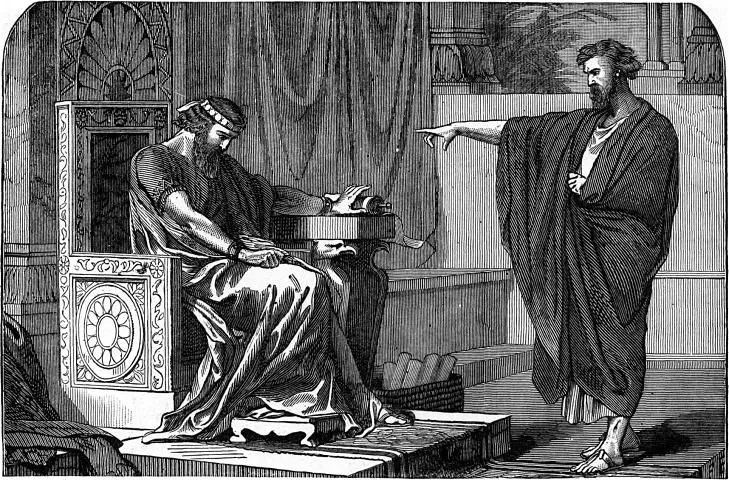
The Curse of King Jeconiah
Skeptics say that since Jesus descended from the cursed King Jeconiah, he cannot be the Messiah. But the Bible proves this argument wrong.
Jeconiah appears in Matthew’s lineage of Jesus. But Jeremiah 22:30 says of King Jeconiah, the son of King Josiah: “Thus says the LORD: Write this man down as childless, a man who shall not succeed in his days, for none of his offspring shall succeed in sitting on the throne of David and ruling again in Judah.”
This curse disqualifies any of Jeconiah’s descendants from being King of the Jews. Some scholars argue that since Jesus was not the biological son of Joseph, the curse does not apply to him. However, if Jesus inherits the royalty of King David through the ancestry of Joseph, his legal, adoptive father, it stands to reason Jesus would also inherit the curse of Jeconiah through him, too.
There is consistent with the Bible. That solution is that the Jeconiah cursed in Jeremiah 22 is a different man from the Jeconiah named by Matthew in Jesus’ genealogy.
Matthew 1:11-13 says: “and Josiah the father of Jechoniah and his brothers, at the time of the deportation to Babylon. And after the deportation to Babylon: Jechoniah was the father of Shealtiel, and Shealtiel the father of Zerubbabel, and Zerubbabel the father of Abiud…”
1 Chronicles 3 says that King Josiah had four sons, in this order:
1. Johanan, who never became king although he was the firstborn;
2. Eliakim, whose name changed to Jehoiakim when he became king;
3. Mattaniah, whose name changed to Zedekiah when he became king;
4. Shallum, whose name changed to Jehoahaz when he became king.
Matthew says that Josiah “begot” Jeconiah (also called Coniah or Jehoiachin), but 1 Chronicles 3 states that Josiah was the grandfather of Jeconiah, whose father was Josiah’s son, Jehoiakim. This is not a contradiction. It is a perfectly fine use of language to say that my grandfather begot me, even though he begot my father who begot me.
However, there is a problem. Matthew says that Jeconiah had brothers– plural – who were carried away to Babylon.
But 1 Chronicles 3:16 says that King Jehoiakim had only two sons – Jeconiah and Zedekiah. Therefore, King Jeconiah had only one brother, who was carried away to Babylon – not plural brothers as Matthew 1:11 states.
The Jeconiah in Matthew 1:11 is a different man from King Jeconiah.
Who was Matthew’s Jeconiah? He could be Johanan, the son of King Josiah. This fits the obvious statement in Matthew 1 that King Josiah begot Jeconiah (Johanan) and the statement in 1 Chronicles 3 that Johanan was King Josiah’s firstborn son.
This requires us to believe that Johanan had a second name: Jeconiah.
Since all three of Johanan’s brothers had second names, it is reasonably likely that Johanan had a second name, too.
Here are the names and second names (royal names) of King Josiah’s sons:
Johanan – Jeconiah (possibly planned royal name)
Eliakim – Jehoiakim (royal name when he became king)
Mattaniah – Zedekiah (royal name when he became king)
Shallum – Jehoahaz (royal name when he became king)
You might object that Eliakim, Mattaniah, and Shallum had their names changed because they became kings, and that Johanan would not have had his name changed, because he did not become a king.
The response to this objection is that not everyone in the Bible who had a name change or dual names became a king. Jesus gave Simon the nickname of Peter. Nebuchadnezzar changed the name of Daniel to Belteshazzar, and Daniel’s three colleagues, Hananiah, Mishael, and Azariah had their names changed to Shadrach, Meshach, and Abednego. None of these people became kings.
Oddly, Johanan, the firstborn son of Josiah, did not become king, even though all three of his younger brothers didbecome kings.
King Josiah died in battle against Pharaoh Necho II in the great war when Egypt and Assyria fought and lost against Babylon.
After King Josiah’s death, Jehoahaz (also known as Shallum) became king at the age of 23, even though he was two years younger than Eliakim, his brother. He reigned only three months, after which Pharaoh Necho took him captive into Egypt.
Pharaoh Necho made Eliakim, the second son of King Josiah, the King of Judah, changing his name to Jehoiakim. He reigned for 11 years.
In 598 B.C., Nebuchadnezzar took Jehoiakim bound in fetters to Babylon and installed Jehoiakim’s son, Jeconiah (also known as Coniah and Jehoiachin, the cursed one) on Judah’s throne. But after three months and ten days, Nebuchadnezzar deposed Jeconiah, took him captive to Babylon, and installed Jeconiah’s uncle, Mattaniah, on the throne of Judah, changing his name to Zedekiah. When Nebuchadnezzar finally destroyed Jerusalem in 586 B.C., he blinded Zedekiah and took him captive into Babylon.
Thus, two of Johanan’s brothers, Jehoiakim and Zedekiah, were taken captive into Babylon.
It is possible that Johanan was given a regal name, like his brothers, in preparation to become King of Judah. It is possible that the name he received was Jeconiah, which means “God has established” or “established by God.” In these turbulent times, when Josiah’s sons and grandson took the throne, not in order of their birth, but in compliance with the dictates of the foreign warlords of Egypt and Babylon, Johanan never got the chance to rule Judah, as should have been his right as the firstborn of King Josiah. Perhaps he died in battle before he could wear the crown. Or perhaps Pharaoh Necho and Nebuchadnezzar disapproved of him.
How can we verify if Johanan is really the uncursed Jeconiah in Jesus’ lineage?
1 Chronicles 3:17-19 says that Jeconiah (who was cursed) had a son named Shealtiel and a son named Zerubbabel. Matthew 1:12 says that the Jeconiah (in Jesus’ ancestry) had a son named Shealtiel and a son named Zerubbabel. Since bothJeconiahs had a son named Shealtiel and a grandson named Zerubbabel, are they the same man? No.
Matthew says Jeconiah had brothers (plural), while 1 Chronicles 3 says that Jeconiah had only one brother, Zedekiah.
1 Chronicles 3:17-18 says that Jeconiah was, indeed, the father of Shealtiel, but he was also the father of Pedaiah. So this Jeconiah had two sons, Shealtiel and Pedaiah, and in this family, Pedaiah, not Shealtiel was the father of Zerubbabel.
The Zerubbabel in Matthew (the grandson of the uncursed Jeconiah) had a father named Shealtiel and a son named Abiud. The Zerubbabel in 1 Chronicles 3, the grandson of the cursed Jeconiah, had a father named Pedaiah and eight children (as follows), not one of whom was named Abiud:
1. Meshullam,
2. Hananiah,
3. Shelomith
4. their sister, Hashubah,
5. Ohel,
6. Berechiah,
7. Hasadiah, and
8. Jushab-hesed.
Therefore, the only person who could have:
· Been a son of Josiah
· Had plural brothers who were carried off to Babylon
· Had a son named Shealtiel, who had a son named Zerubbabel, who had a son named Abiud
is Johanan, the firstborn son of King Josiah. Therefore, Johanan must have received a given name, Jeconiah, and Jesus descended from him, not from the cursed King Jeconiah.
So also Zerubbabel, who led the Jews back from Babylon to Jerusalem, along with Jeshua the priest, was also not of King Jeconiah’s cursed line but was a descendant of Johanan (Jeconiah), who was never king and was never cursed. And this Jeconiah was an ancestor of Jesus.
Of King Jeconiah, God said, “As I live, declares the LORD, though Coniah the son of Jehoiakim, king of Judah, were the signet ring on my right hand, yet I would tear you off and give you into the hand of those who seek your life, into the hand of those of whom you are afraid, even into the hand of Nebuchadnezzar king of Babylon and into the hand of the Chaldeans.” (Jeremiah 22:24-25)
So, God likened King Jeconiah to a signet ring that he tore off his right hand.
By contrast, of Zerubbabel, God said, “I will take you, O Zerubbabel my servant, the son of Shealtiel, declares the LORD, and make you like a signet ring, for I have chosen you, declares the LORD of hosts.” (Haggai 2:23)
God likened Zerubbabel to a signet ring that he had chosen.
In Zechariah, God says, “This is the word of the Lord to Zerubbabel: ‘Not by might nor by power, but by my Spirit,’ says the Lord Almighty. What are you, mighty mountain? Before Zerubbabel, you will become level ground. Then he will bring out the capstone to shouts of ‘God bless it! God bless it!’ Then the word of the Lord came to me: ‘The hands of Zerubbabel have laid the foundation of this temple; his hands will also complete it. Then you will know that the Lord Almighty has sent me to you. Who dares despise the day of small things, since the seven eyes of the Lord that range throughout the earth will rejoice when they see the chosen capstone in the hand of Zerubbabel?”
This Zerubbabel – clearly not cursed – was the leader of the Jews back from Babylon to Jerusalem. His mission was to restore the worship in the temple that Nebuchadnezzar destroyed. He was the descendant of righteous King Josiah and acted in the role of Judah’s king – even though he was a governor under the overlordship of King Cyrus of Persia. Interestingly, the High Priest who accompanied Zerubbabel was named Jeshua – Jesus in Greek.
So, Zerubbabel, Jesus’ ancestor, became the ruler of the Jews as they returned from Babylon under the guidance of a High Priest who was Jesus’ namesake.
In Acts 4:11-12, Peter told the Sanhedrin, “This Jesus is the stone that was rejected by you, the builders, which has become the cornerstone. And there is salvation in no one else, for there is no other name under heaven given among men by which we must be saved.”
The righteous Zerubbabel, chosen and blessed by God, brought forth the literal capstone – that used to rebuild the temple – and the figurative capstone of the living temple, God’s people, the church, in the person of Jesus Christ, was the descendant of this blessed Zerubbabel.
The only possible and correct ancestry of Jesus is completely consistent with the texts of 1 Chronicles, 2 Kings, Jeremiah, Haggai, Zechariah, and Matthew.
The cursed King Jeconiah had the same name as his uncursed uncle Jeconiah, who was the firstborn of King Josiah but who never got to wear Judah’s crown.
The cursed Zerubbabel had the same name as his uncursed cousin Zerubbabel. (The name Zerubbabel is not Hebrew, but Aramaic. It means “the seed of Babylon.” Since both men of this name would have been born in the Babylonian exile, this is hardly a strange name for them. It may even have been a kind of a title.)
In conclusion, Jesus descends from King David but not through the cursed King Jeconiah but through the uncursed Prince Jeconiah (Johanan), who should have been King of Judah, and is therefore not barred from being King of the Jews through God’s curse on King Jeconiah. David’s sons were priests (2 Samuel 18:18), and David sometimes wore the priestly ephod and presented sacrifices to Yahweh (2 Samuel 6:14, 18 and 24:25). In Jesus kingly and priestly lineages combined.