


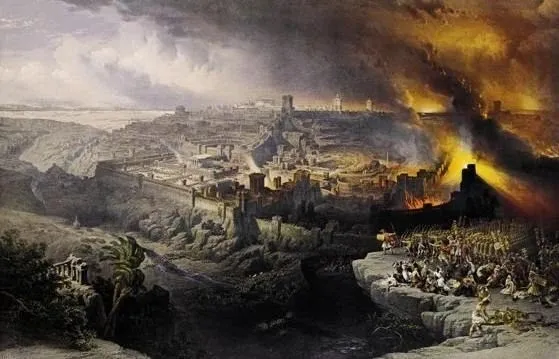
The Fall of Two Temples
Post Content:
Ironically, on the same day, 656 years apart, the 9th of Av (today’s date, August 9, 2019), the First and Second Temples in Jerusalem were destroyed.
On the 10th day of the Jewish month of Tevet (Friday, December 11) in 588 B.C., King Nebuchadnezzar of Babylon arrived with his army at Jerusalem. Ten days later, on 20 Tevet (Monday, December 21), he laid the city under siege.
After 551 days, on the 9th day of the Jewish month of Tammuz (Friday, June 24) in 586 B.C., the Babylonians breached the city walls.
On the 7th day of the Jewish month of Av (Thursday, July 21), the Captain of Nebuchadnezzar’s bodyguard came to the city and prepared to set it ablaze.
On the 9th of Av, Saturday, the Sabbath, July 23, in 586 B.C. the First Temple, completed by King Solomon 373 years before, in 959 B.C., burned to the ground.
Nebuchadnezzar took most of the Jews to Babylon, in exile.
In 539 B.C., Cyrus the Great of Persia conquered Babylon and decreed that the Jews could return to their homeland, Judea.
The Jews completed a Second Temple in Jerusalem on the 3rd day of the Jewish month of Adar (Friday, February 13) in 515 B.C, 70 years after being exiled to Babylon.
In 63 B.C., Rome conquered the Middle East and occupied Judea. After 129 years, in 66 A.D., the Jews revolted against Roman rule. The Emperor Nero sent the Twelfth Legion to suppress the uprising, but the Jews killed 5,000 Romans, annihilating the legion.
In 67 A.D., Nero appointed a Roman general, Vespasian, to crush the Jews. Vespasian defeated the Jews in Galilee, but halted hostilities when Nero was assassinated in 68 A.D.
For the next year, the Year of the Four Emperors, 69 A.D., four Roman generals vied for the imperial crown. Vespasian prevailed, became emperor on December 21, and appointed his son, Titus, to finish off the Jews.
On April 14, a few days before the Passover of 70 A.D., Titus laid siege to Jerusalem. He placed three legions on the western side of the city and a fourth on the Mount of Olives to the east. The siege lasted 4 months, 3 weeks, and 4 days. In July, the Romans captured the Antonia Fortress, which overlooked the Temple.
Titus planned to seize the Temple and convert it into a Roman temple, but a soldier threw a blazing stick over the Temple walls, and the fire spread out of control. The Second Temple burned to the ground on the 9-10 Av, from Saturday, the Sabbath, August 2 to Sunday, August 3, 70 A.D.
Jesus had prophesied this. “Jesus left the Temple and was going away, when his disciples came to point out to him the buildings of the Temple. But he answered them, ‘You see all these, do you not? Truly I say to you that there will be not one stone left upon another that will not be thrown down.'” (Matthew 24:1)
And so had Daniel foretold it: “And the people of the prince who is to come shall destroy the city and the sanctuary. Its end shall come with a flood, and to the end there shall be war. Desolations are decreed.” (Daniel 9:26) Titus was indeed a prince, the son of the Emperor Vespasian.
By September 8, 70 A.D., the Roman pacification of Jerusalem was complete. But the Jewish War dragged on in outlying regions, until the Romans besieged the last rebel outpost, Masada, in 73 A.D. Its defenders, 960 men, women, and children, committed mass suicide. Only two women and five children survived. (Josephus, The Jewish War Book VII, Chapter 9)